Greater Hartford's Gutter Experts

Downspout Installation & Repair

Hartford properties absorb 49 inches of rainfall annually, and every drop that lands on the roof must travel through the downspout system before it reaches the ground. Properly sized, positioned, and maintained downspouts are the critical link between functional gutters and a dry foundation.

Why Downspouts Matter

Gutters collect water. Downspouts move it. Without an adequate downspout system, even the best gutter installation becomes a decorative trough that overflows onto the very surfaces it was designed to protect. In the greater Hartford area, where annual rainfall averages 49 inches and snowmelt adds additional volume from November through March, downspout capacity directly determines whether a home's foundation stays dry or develops costly water intrusion problems.

Foundation repair in Connecticut routinely costs $5,000 to $15,000 or more depending on the extent of the damage. Basement waterproofing runs $3,000 to $10,000. Landscaping erosion, stained siding, and deteriorated walkways add thousands more. The common thread in most of these failures traces back to water that was not moved far enough away from the structure — a problem that properly configured downspouts solve at a fraction of the repair cost.

Connecticut's position in IECC Climate Zone 5A adds a freeze-thaw dimension that makes downspout performance even more critical. Water that pools near a foundation freezes and expands during winter months, exerting lateral pressure against basement walls. Repeated freeze-thaw cycling between November and March can crack poured concrete and push block walls inward over time. Downspouts that discharge water 4 to 6 feet from the foundation eliminate the standing water that makes freeze-thaw damage possible.
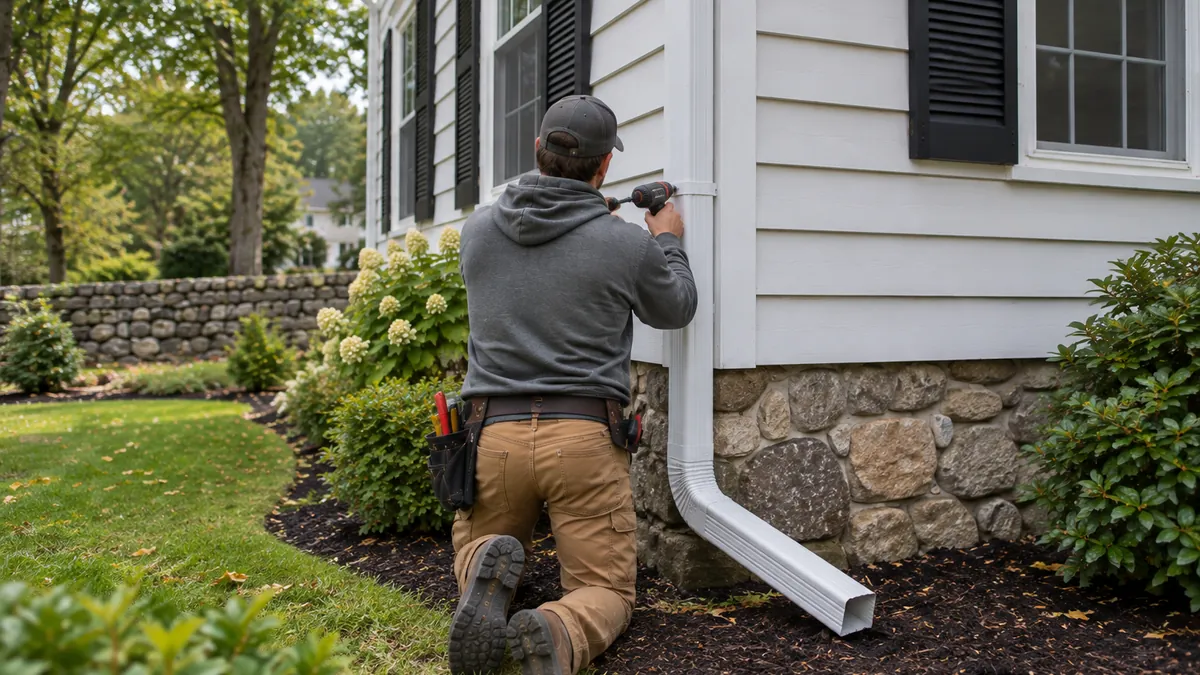
Professional downspout installation on a Hartford home
49″
Annual Rainfall
$5K–$15K
Foundation Repair Cost
4–6 ft
Min Discharge Distance
Zone 5A
IECC Climate Zone

Downspout Types & Configurations

The right downspout configuration depends on gutter profile, roof area, and how far water needs to travel from the structure. Hartford properties typically use one of several standard configurations.

Most Common

Rectangular Downspouts

Available in 2x3-inch and 3x4-inch profiles, rectangular downspouts are the standard for residential K-style gutter systems. The 2x3 size handles most single-story applications, while the larger 3x4 profile is recommended for homes with steep roof pitches, large collection areas, or sections where Hartford's heavy spring rainfall overwhelms smaller downspouts.

Best for: Standard residential installations with K-style gutters.

Round Downspouts

Round downspouts in 3-inch or 4-inch diameters pair with half-round gutter profiles commonly found on older Hartford homes, particularly in neighborhoods like West End and Asylum Hill. The smooth interior resists debris accumulation better than rectangular profiles, reducing clog frequency in areas with heavy tree canopy from sugar maples and red oaks.

Best for: Historic homes and half-round gutter systems.

Extensions & Splash Blocks

Surface extensions attach to the downspout base and direct water across the grade away from the foundation. Hinged extensions fold up for mowing. Splash blocks are concrete or plastic pads positioned beneath the downspout outlet to prevent soil erosion at the discharge point. Both solutions work best on properties with adequate grading away from the structure.

Best for: Properties with good natural slope and open yard space.

Underground Drain Lines

Buried PVC pipe connects the downspout base to a pop-up emitter, dry well, or daylight outlet positioned 10 to 20 feet from the structure. Underground systems eliminate surface extensions that interfere with walkways and landscaping, and they align with best practices outlined in the EPA's guide to reducing stormwater runoff. Proper slope of at least one-quarter inch per foot prevents standing water that can freeze and crack the pipe during Connecticut winters.

Best for: Properties with limited yard space or where surface extensions create obstacles.

Schedule a Downspout Assessment

A thorough evaluation of downspout placement, capacity, and discharge patterns — at no cost and with no obligation.

Call Now — (860) 351-1682

Signs of Downspout Problems

Downspout failures do not always announce themselves with dramatic leaks or visible damage. Many problems develop gradually over seasons, producing subtle warning signs that homeowners may attribute to other causes. Recognizing these indicators early prevents the kind of cascading water damage that turns a straightforward downspout repair into a major foundation or siding project.

  • Water pooling near the foundation — Standing water within 2 feet of the foundation wall after rain indicates downspouts that are too short, misaligned, or clogged. This is the single most damaging downspout failure mode for Hartford homes.
  • Gutter overflow during moderate rain — When gutters overflow even during average rainfall, the bottleneck is usually at the downspout opening. Debris accumulation from Connecticut's dense tree canopy — particularly sugar maple seeds and oak leaves — frequently blocks the transition from gutter to downspout.
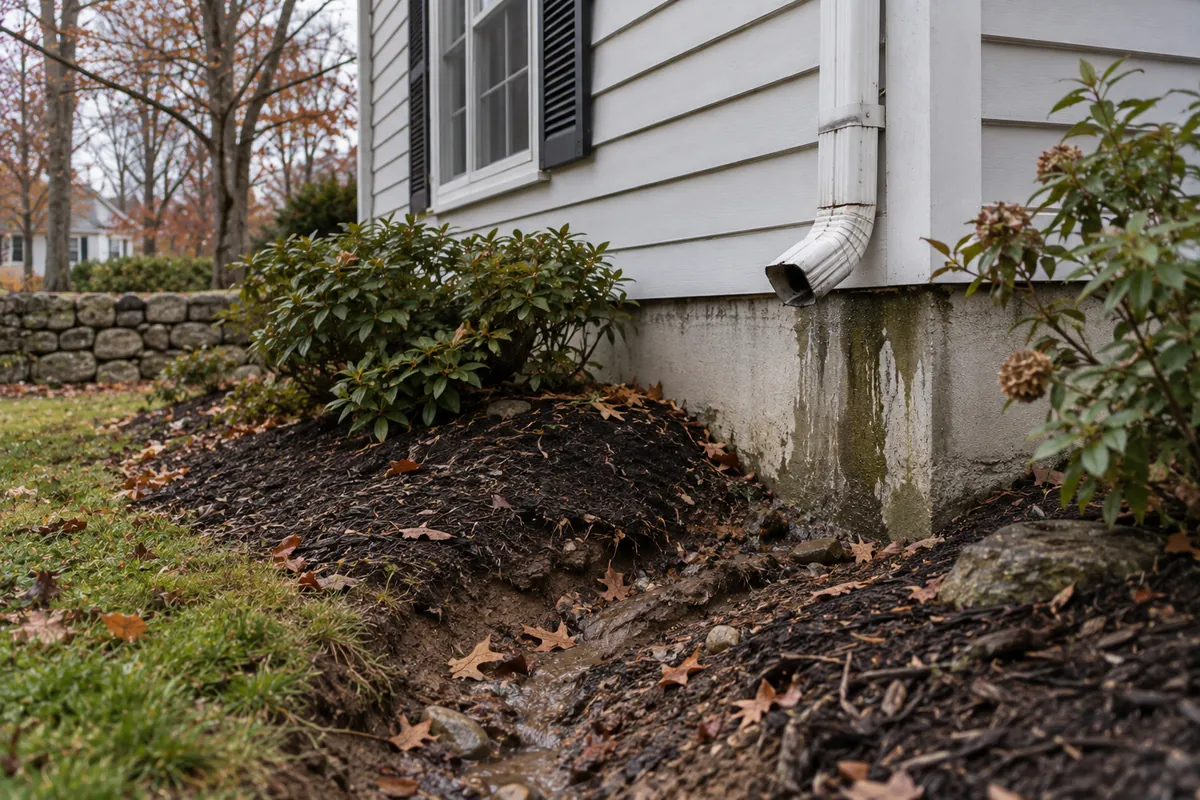
  • Staining or erosion below downspout outlets — Soil erosion channels, mulch displacement, or mineral staining on concrete beneath downspout openings signals concentrated discharge without adequate extension or splash protection.
  • Ice forming at downspout bases — During Hartford's freeze-thaw season from November through March, ice buildup at the base of downspouts indicates water is not draining away from the discharge point. Frozen pools near downspouts generate the lateral pressure that cracks foundations over time.
  • Basement dampness or musty odors — Persistent humidity or musty smells in the basement during or after rain events often traces to inadequate downspout discharge rather than rising groundwater. The fix is typically redirecting downspout output rather than installing interior waterproofing.
Signs of downspout problems on a Hartford property
38–48″
Annual Snowfall
#1
Tree Canopy Ranking
Nov–Mar
Freeze-Thaw Season

Downspout Pricing

Service Price Range Notes
Downspout Installation (Aluminum) $5 – $12 / LF Standard rectangular or round; includes mounting hardware
Downspout Extension $30 – $75 each Surface extension; hinged or fixed options
Splash Block $10 – $30 each Concrete or heavy-duty plastic; prevents soil erosion
Underground Drain Line $10 – $25 / LF Buried PVC to pop-up emitter or dry well
Downspout Repair $75 – $250 Reattachment, elbow replacement, seam sealing
Downspout Relocation $150 – $400 Moving discharge point to improve drainage pattern

Connecticut requires Home Improvement Contractor (HIC) registration for projects exceeding $200. Homeowners should verify current HIC registration status before authorizing any downspout or gutter work. Visit the CT Department of Consumer Protection for contractor verification.

Prices reflect typical ranges in the greater Hartford area as of 2026. Actual costs depend on downspout length, material, configuration, and site-specific conditions. Multi-downspout projects may qualify for volume pricing.

Frequently Asked Questions

Common questions about downspout services for Hartford and greater Hartford County properties.

Most residential properties in the greater Hartford area require one downspout for every 20 to 30 linear feet of gutter run. A standard single-story home typically needs 4 to 6 downspouts, while larger two-story homes or properties with complex rooflines may need 6 to 10. Hartford's 49 inches of annual rainfall makes adequate downspout count critical for preventing overflow and foundation saturation.
Downspout extensions should direct water at least 4 to 6 feet away from the foundation wall. In areas with clay-heavy Connecticut soils that drain slowly, extending discharge to 8 or even 10 feet provides additional protection. Underground drain lines connected to a pop-up emitter or dry well offer the most effective solution for properties where surface extensions create obstacles in walkways or landscaped areas.
Connecticut ranks among the highest states for urban tree canopy coverage, and Hartford area homes are surrounded by sugar maples, red maples, and oaks that shed heavily each fall. Leaves, seed pods, and small twigs wash into gutters and accumulate at the downspout opening where the gutter transitions into the narrower downspout tube. Ice formation during freeze-thaw cycles from November through March compounds the problem by trapping debris in frozen blockages that persist for weeks.
Rectangular downspouts, typically 2x3 inches or 3x4 inches, are the standard for residential K-style gutter systems and handle high water volumes efficiently. Round downspouts, usually 3 or 4 inches in diameter, pair with half-round gutter profiles and are common on historic homes in Hartford's older neighborhoods. Round downspouts resist clogging better because debris has fewer corners to catch on, but rectangular downspouts sit flatter against walls for a cleaner visual profile.
Downspout installation in the greater Hartford area typically ranges from $5 to $12 per linear foot for standard aluminum downspouts, including mounting hardware and elbow fittings. A single downspout run from roofline to ground level on a two-story home averages $75 to $200 depending on length and configuration. Underground drain line extensions add $10 to $25 per linear foot. Connecticut requires Home Improvement Contractor registration for projects exceeding $200.
Underground drainage connections are an effective solution for directing water well away from the foundation without surface extensions that interfere with landscaping or walkways. A buried PVC pipe connects the downspout base to a pop-up emitter, dry well, or daylight outlet positioned 10 to 20 feet from the structure. Proper slope of at least one-quarter inch per foot is essential to prevent standing water in the line, which can freeze and crack pipes during Connecticut winters.

For more information about Connecticut weather patterns and climate data, visit the National Weather Service. Homeowners with questions about contractor protections can consult the Connecticut Department of Consumer Protection.

Protect the Foundation From Connecticut Rain

Free downspout assessments for residential properties in Hartford, West Hartford, East Hartford, Manchester, Glastonbury, and surrounding communities.

Call For a Free Estimate