Greater Hartford's Gutter Experts

Seamless Gutter Systems

Connecticut's freeze-thaw cycling splits sectional gutters at the joints. Seamless systems eliminate those failure points entirely — one continuous piece of aluminum per gutter run, fabricated on-site to the exact dimensions of the roofline, with zero seams where ice can force its way through.

Why Seamless Gutters Matter in Connecticut

Every joint in a sectional gutter system is a future leak. Sectional gutters connect in 10- to 20-foot segments, and each connection relies on sealant and mechanical fasteners to keep water inside the channel. That sealant degrades. The fasteners loosen. And in Connecticut's IECC Climate Zone 5A, the freeze-thaw cycling that runs from November through March accelerates every failure mode.

When water trapped in a gutter joint freezes, it expands approximately 9%. That expansion applies outward pressure against the sealant and the joint connection itself. One cycle may not cause visible damage. But Hartford experiences dozens of freeze-thaw crossings each winter, and each crossing weakens the joint incrementally. By the third or fourth winter, sectional joints that looked fine during installation are leaking onto fascia boards, down siding, and along foundation walls.

Seamless gutters solve this problem at the source. Each gutter run is fabricated from a single continuous piece of aluminum — no joints, no sealant between sections, no weak points where ice expansion can gain a foothold. The only connection points are at corners, end caps, and downspout outlets, which represent a fraction of the total joint count in a sectional system. For Hartford homes facing 49 inches of annual rainfall and 38 to 48 inches of snowfall, the reduction in failure points translates directly to fewer repairs, less water damage, and a longer-lasting gutter system.

Seamless gutter system installed on a Hartford home
0
Mid-Run Joints
On-Site
Custom Fabrication
20–30 yr
Expected Lifespan
49″
Annual Rainfall

How Seamless Gutters Are Made

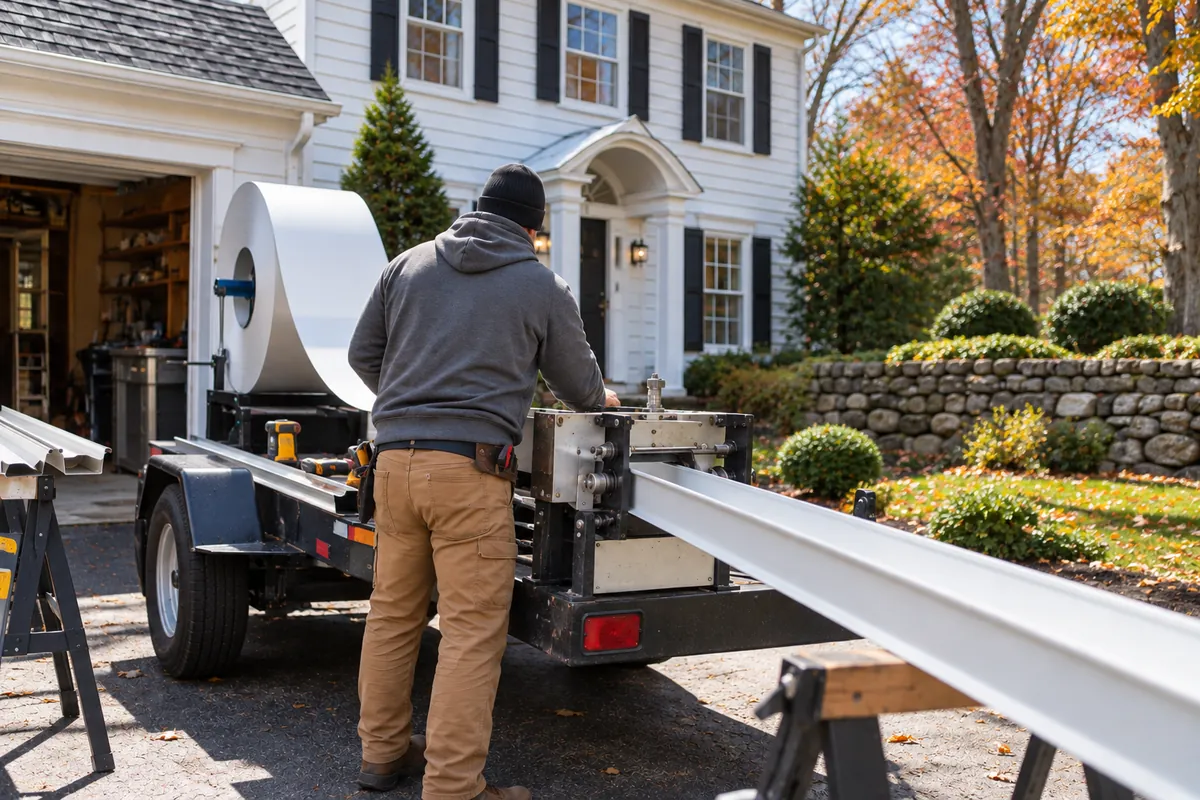
Seamless gutter fabrication happens at the property, not in a factory. A portable roll-forming machine, mounted on an installation trailer, transforms flat aluminum coil stock into finished gutter profiles in a single pass. The process takes minutes per section and produces a gutter run cut to the exact length required — whether that is 12 feet for a short garage wall or 60 feet for the full front elevation of a colonial.

1

Precision Measurement

Every gutter run along the roofline is measured individually. Slope angles, downspout positions, and corner transitions are documented. Nothing is estimated — dimensions are recorded to the nearest eighth of an inch to ensure each section fits precisely.

2

Coil Stock Selection

Flat aluminum coil stock, typically 0.027-inch or 0.032-inch gauge, feeds into the roll-forming machine. The heavier 0.032 gauge is recommended for Connecticut installations where ice loads add significant weight during winter months. Color is selected from factory-finished coil to match trim and fascia.

3

Roll Forming

The coil passes through a series of progressive rollers that bend the flat stock into the desired profile — K-style or half-round. The aluminum emerges as a continuous, finished gutter section at the exact length specified. No cutting and reconnecting. No splices. One piece.

4

Installation & Sealing

Hidden hanger brackets are installed at 18- to 24-inch intervals for Connecticut ice loads. The seamless gutter section is mounted with proper slope toward downspout locations. End caps, corners, and downspout connections are sealed with cold-weather-rated gutter sealant. The system is water-tested before the crew leaves.

On-site seamless gutter roll-forming fabrication
0.032″
Recommended Gauge
18–24″
Hanger Spacing
1 Day
Same-Day Install

Schedule a Free Seamless Gutter Assessment

A complete evaluation of the existing roofline, fascia condition, and drainage requirements — at no cost and with no obligation.

Call Now — (860) 351-1682

Seamless vs. Sectional Gutters

Understanding the differences helps Hartford homeowners make an informed decision about which system best suits the property and the Connecticut climate.

Feature Seamless Sectional
Joints per 100 ft Corners & endpoints only (2–4) 5–10 mid-run joints plus corners
Leak potential Minimal — only at end caps and corners Every joint is a potential leak point
Freeze-thaw resilience No mid-run joints for ice to exploit Ice expansion splits joints over repeated cycles
Custom fit Fabricated to exact roofline dimensions on-site Pre-cut sections; shimming and adjusting required
Appearance Clean, continuous lines with no visible seams Visible joints every 10–20 feet
Typical lifespan 20–30 years (aluminum) 10–20 years before joint failures
Maintenance Biannual cleaning; rare joint re-sealing Biannual cleaning plus periodic joint re-sealing
DIY installation No — requires roll-forming equipment Possible but not recommended for CT climate

Material Options

Seamless gutters are available in several materials. The right choice depends on budget, aesthetic preferences, and how the material handles Connecticut's climate demands.

Most Popular

Aluminum

The standard for residential seamless gutters across the Hartford metro. Aluminum handles freeze-thaw cycling without cracking, resists corrosion from road salt splash, and accepts factory-applied color finishes. Available in 0.027-inch and 0.032-inch gauges. The heavier gauge is recommended for Connecticut properties exposed to significant ice loading.

Lifespan: 20–30 years with proper maintenance.

Copper

A premium material that develops a distinctive verdigris patina over time. Copper delivers exceptional longevity and handles freeze-thaw stress without fatigue cracking. Copper seamless gutters require soldered joints at corners and transitions rather than mechanical fasteners. Ideal for historic properties in Hartford's older neighborhoods and high-end custom homes.

Lifespan: 50–80 years.

Galvanized Steel

Offers superior structural strength for properties with very large roof areas or commercial applications. Steel handles extreme ice loads better than aluminum but weighs more and requires more robust hanger systems. The zinc coating provides corrosion resistance, though it will eventually wear in areas exposed to standing water or high-salt environments.

Lifespan: 20–25 years.

Not Recommended

Vinyl (Sectional Only)

Vinyl gutters are not available in seamless configurations and are not recommended for IECC Climate Zone 5A. Repeated freezing makes vinyl brittle within 3 to 5 years, leading to cracks, splits, and catastrophic failures during ice events. The material also expands and contracts more than metal with temperature swings, loosening connections at joints and endcaps.

Lifespan in Connecticut: 3–7 years before significant failure.

Gutter Sizing for Hartford Properties

Standard

5-Inch K-Style

The most common residential profile in the Hartford area. Five-inch K-style gutters handle rainfall from moderate roof areas effectively and fit standard fascia boards without modification. The flat-back K-style profile sits flush against the fascia for a clean appearance. Suitable for most single-story homes and two-story homes with standard roof pitches.

High Capacity

6-Inch K-Style

Recommended for homes with steep roof pitches, large collection areas, or roof sections where multiple planes converge. The 6-inch profile holds approximately 40% more water than the 5-inch, reducing overflow during Connecticut's heaviest storms. Properties surrounded by sugar maples and red oaks also benefit from the wider opening, which resists clogging from leaf debris.

Half-Round

A curved profile commonly found on historic Hartford homes, particularly in neighborhoods predating the 1950s. Half-round gutters are available in 5-inch and 6-inch diameters and pair with round downspouts. The smooth interior sheds debris more readily than the angular K-style channel, though capacity per inch of width is slightly lower.

Choosing the Right Size

Proper sizing depends on three factors: roof square footage draining to each gutter run, roof pitch (steeper pitches shed water faster, concentrating volume), and local rainfall intensity. Hartford's 49 inches of annual rainfall, combined with intense summer thunderstorms that can deliver an inch per hour, makes undersizing a costly mistake. An on-site assessment determines the correct profile and dimension for each section of the roofline.

Seamless Gutter Pricing

Material / Profile Price Range Notes
Aluminum 5" K-Style $5.70 – $10 / LF Most popular residential option in greater Hartford
Aluminum 6" K-Style $7.50 – $12.60 / LF High-capacity for large roofs and steep pitches
Copper $25 – $50 / LF Premium; 50–80 year lifespan; soldered joints
Galvanized Steel $11 – $33 / LF Maximum ice-load capacity; heavier installation
Full Replacement (w/ teardown) $10 – $16 / LF Includes removal of existing system and haul-away
Downspout Installation $5 – $12 / LF Aluminum standard; includes mounting hardware
Gutter Guards (add-on) $7 – $20 / LF Micro-mesh recommended for Connecticut's heavy tree canopy

Connecticut requires Home Improvement Contractor (HIC) registration for projects exceeding $200. Homeowners should verify current HIC registration status before authorizing any gutter work. Visit the CT Department of Consumer Protection for contractor verification.

Prices reflect typical ranges in the greater Hartford area as of 2026. Actual costs vary based on home size, roofline complexity, material selection, and site-specific conditions.

Frequently Asked Questions

Common questions about seamless gutter systems for Hartford and greater Hartford County properties.

Seamless gutters are fabricated from a single continuous piece of aluminum for each gutter run, eliminating the joints every 10 to 20 feet where sectional gutter pieces connect. Those joints are the primary failure point in gutter systems because sealant deteriorates over time and water expands 9% when it freezes, splitting weakened seams. In Connecticut's IECC Climate Zone 5A, where freeze-thaw cycling occurs repeatedly from November through March, seamless construction provides significantly longer service life and fewer leak-related repairs.
A portable roll-forming machine is brought to the property on an installation trailer. Flat aluminum coil stock, typically 0.027-inch or 0.032-inch thickness, feeds through a series of rollers that progressively bend the metal into the desired gutter profile. The machine produces a continuous gutter section cut to the exact length needed for each run of the roofline. This process takes only minutes per section and ensures a precise fit with no splices.
Seamless aluminum gutter installation in the greater Hartford area ranges from $5.70 to $12.60 per linear foot depending on gutter size, material gauge, and installation complexity. A typical single-story home with 150 to 200 linear feet of guttering runs $855 to $2,520 installed. Two-story homes and properties with complex rooflines fall in the $1,500 to $3,500 range. Connecticut requires Home Improvement Contractor registration for projects exceeding $200.
Seamless aluminum gutters typically last 20 to 30 years in Connecticut's climate with proper maintenance including biannual cleaning. The absence of joints eliminates the most common failure point, and aluminum resists the corrosion that affects steel in salt-treated environments. Copper seamless gutters can last 50 to 80 years. Regular inspection of hanger connections, end caps, and downspout transitions extends service life regardless of material.
Five-inch K-style gutters are the standard for most Hartford-area residential properties and handle rainfall from average roof areas effectively. Six-inch K-style gutters are recommended for homes with steep roof pitches, large roof surface areas, or sections that collect runoff from multiple roof planes. Hartford receives 49 inches of annual rainfall, so undersized gutters overflow during heavy storms and concentrate water near the foundation. Half-round profiles in 5-inch or 6-inch sizes are available for historic homes.
Seamless gutters can be installed year-round in Connecticut, though installation during temperatures above 20 degrees Fahrenheit is preferred. Cold temperatures make sealant less pliable and require longer curing times at joints, end caps, and downspout connections. The aluminum coil stock itself performs well in cold weather. Winter installation is common for emergency replacements or when damage from ice events requires immediate attention to prevent further water intrusion.

For more information about Connecticut weather patterns and climate data, visit the National Weather Service. Homeowners with questions about contractor protections can consult the Connecticut Department of Consumer Protection.

Seamless Gutters Built for Connecticut Winters

Free on-site assessments for residential properties in Hartford, West Hartford, East Hartford, Manchester, Glastonbury, and surrounding communities.

Call For a Free Estimate