Connecticut's nation-leading tree canopy fills gutters faster than almost anywhere else in the country. Sugar maples, red oaks, and silver maples drop leaves, samaras, and seed pods across a two-month fall season — and the debris cycle runs year-round. Gutter guards cut cleaning frequency by 80 to 90 percent.
Connecticut ranks first in the nation for urban tree canopy density, with approximately 60% forest cover statewide and 67% tree canopy across its municipalities. For Hartford-area homeowners, that statistic translates into a relentless gutter maintenance burden. The dominant species lining streets and yards throughout Hartford County — sugar maple, red maple, white oak, red oak, scarlet oak, and silver maple — each contribute distinct debris types at different points in the calendar.
The fall leaf drop is the most visible event, but it is far from the only one. Silver maples release thousands of helicopter-shaped samaras in late spring. Oaks shed catkins and pollen clusters in April and May. Summer storms break twigs and small branches that settle into gutter troughs. By the time the heavy leaf drop arrives in October and November, gutters that were cleaned in spring may already be half-full of accumulated organic material.
Without gutter guards, Hartford-area properties typically require three to four cleanings per year to keep gutters functional. Each cleaning event costs between $109 and $361 for a typical home in Hartford County. Over a five-year span, that maintenance cost approaches or exceeds the one-time investment in a quality guard system. Beyond the economics, clogged gutters in Connecticut's IECC Climate Zone 5A create a direct pathway to ice dam formation during the November-through-March freeze-thaw season — a risk the February 2026 blizzard made painfully clear to homeowners across the region.
Gutter guards reduce cleaning frequency by 80 to 90 percent for most Hartford-area homes, shifting maintenance from multiple labor-intensive trough cleanings per year to a single annual surface inspection.
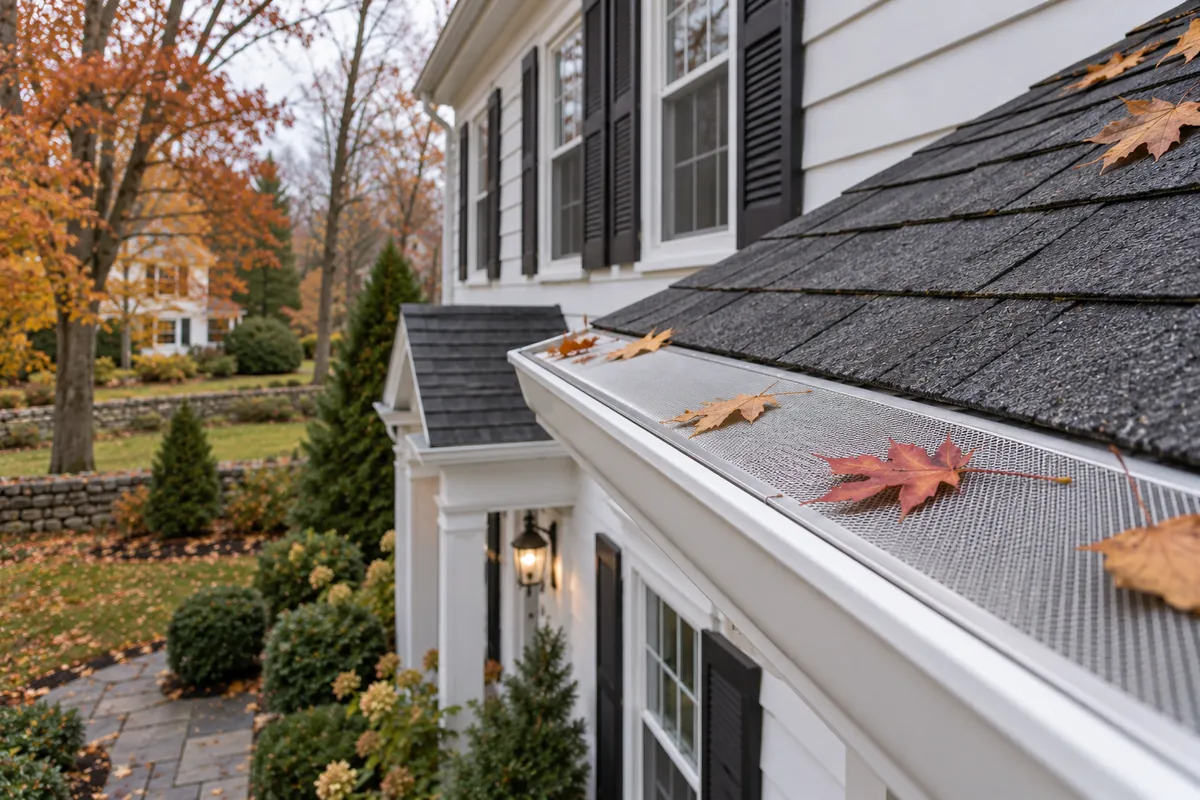
Each guard type handles Hartford's debris profile differently. The right choice depends on the specific tree species surrounding the property, roof pitch, and budget.
Perforated steel or aluminum screens that sit over the gutter opening, blocking large leaves and twigs while allowing water to flow through. Effective against the broad leaves from Hartford's maples and oaks but less effective against fine debris like pine needles, shingle grit, and maple samaras that can pass through the openings or accumulate on the screen surface.
Best for: Properties with primarily large-leaf deciduous trees and homeowners seeking an affordable entry point.
Maintenance: Periodic brushing of surface debris; occasional removal for cleaning underneath.
Price: $5.10 – $6.90 / LF installed
Solid covers that use surface tension to direct water around a curved nose into the gutter while debris slides off the edge. Effective against leaves and large debris, but fine materials like maple samaras and oak catkins can follow the water curve into the trough. Performance is affected by heavy rainfall — during high-volume Connecticut storms, water can overshoot the curve entirely.
Best for: Properties where the primary concern is large leaf accumulation and roof pitch allows proper water adhesion.
Maintenance: Periodic nose-edge clearing; occasional professional inspection.
Price: $7.20 – $10.30 / LF installed
Fine stainless steel mesh over an aluminum frame that blocks virtually all debris — including maple samaras, pine needles, shingle grit, and pollen clusters — while allowing water to pass through microscopic openings. The highest-performing option for Hartford's dense canopy environment. Handles heavy rainfall without overshooting and maintains filtration performance through freeze-thaw cycling.
Best for: Properties with mixed canopy (maples, oaks, conifers) and homeowners seeking maximum debris reduction.
Maintenance: Annual surface brushing; minimal trough cleaning required.
Price: $8 – $20 / LF installed
A free on-site assessment identifies the debris types, roof pitch, and gutter configuration specific to the property — the factors that determine which guard system performs best.
Call Now — (860) 351-1682Side-by-side comparison of how each guard type handles the specific debris and weather conditions found across Hartford County.
| Feature | Steel Screen | Solid Surface | Micro-Mesh |
|---|---|---|---|
| Large Leaf Blocking | Good | Excellent | Excellent |
| Maple Samara Blocking | Fair — some pass through | Fair — can follow water curve | Excellent — blocked at surface |
| Pine Needle Blocking | Poor — pass through openings | Good | Excellent |
| Shingle Grit Filtration | Poor | Poor — enters with water | Good — most blocked at mesh |
| Heavy Rain Performance | Good | Fair — overshoot risk in storms | Excellent |
| Freeze-Thaw Durability | Good | Good | Excellent |
| Cleaning Reduction | 50–70% | 60–80% | 80–90% |
| Price Range (per LF) | $5.10 – $6.90 | $7.20 – $10.30 | $8 – $20 |
| Typical Lifespan | 10–15 years | 15–20 years | 20–25+ years |
Hartford County market rates as of 2026. Installed pricing includes materials, labor, and standard cleanup. Actual cost depends on gutter length, roof accessibility, and system selected.
| Guard Type | Price per Linear Foot | Typical Home (150–200 LF) |
|---|---|---|
| Steel Screen Guards | $5.10 – $6.90 / LF | $765 – $1,380 |
| Solid Surface / Reverse Curve | $7.20 – $10.30 / LF | $1,080 – $2,060 |
| Micro-Mesh (standard) | $8 – $14 / LF | $1,200 – $2,800 |
| Micro-Mesh (premium stainless) | $14 – $20 / LF | $2,100 – $4,000 |
| National-Brand Systems | $15 – $45 / LF | $2,250 – $9,000 |
National-brand gutter guard systems sold through door-to-door or high-pressure sales tactics typically charge two to four times the price of locally-installed systems using identical micro-mesh technology. The premium covers sales commissions and national marketing budgets, not superior materials. Connecticut requires HIC registration for home improvement work exceeding $200 — homeowners should verify registration through the state's eLicense portal before signing any contract.
Common questions about gutter guards for Hartford and Hartford County properties.
For weather and climate data relevant to gutter guard performance in Connecticut, visit the National Weather Service. Homeowners with questions about contractor registration can consult the Connecticut Department of Consumer Protection.
Free on-site assessments for residential properties in Hartford, West Hartford, East Hartford, Manchester, Glastonbury, and throughout Hartford County.
Call For a Free Estimate